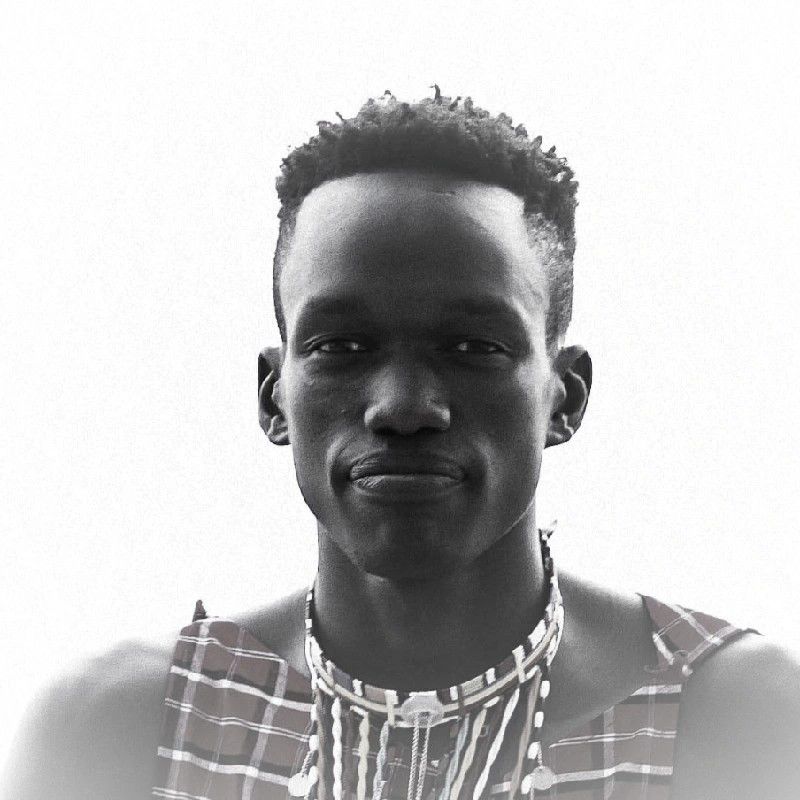
Hi, my name is

kipngeno koech.

I build bridges between minds & machines.

I'm an AI Engineer and Researcher passionate about robotics, vision-language-action models, deep learning, and agentic AI. Currently exploring how robots can see, reason, and act, how intelligent agents push the boundaries of what's possible, and how all of it can interface with the human brain (brain-computer interfaces).

01.About Me

Hello! I'm kipngeno, a researcher and engineer working on robotics and vision-language-action (VLA) models that teach robots to see, reason, and act. I'm also drawn to agentic AI, deep learning, and brain-computer interfaces.

Underneath it all, I care most about the math. The real power of AI comes from linear algebra, probability, and optimization. Understanding the theory is what makes the engineering meaningful, powerful, and trustworthy.

When I'm not coding or researching, you'll find me hiking, traveling, reading, or contributing to the IEEE community.

Here are a few technologies I've been working with recently:

  • VLAs & VLMs
  • Deep Learning & PyTorch
  • Reinforcement Learning
  • Agentic AI
  • Brain-Computer Interfaces
  • Hugging Face
Kipngeno Koech

02.Education

Master of Engineering - Artificial Intelligence

Carnegie Mellon University Africa
Kigali, Rwanda
Apr 2024 - May 2026

Smart Africa Scholar. Graduate TA for Introduction to Deep Learning (11-785) and Bridge Program. Research in computational neuroscience and BCI.

Deep LearningMachine LearningNeural NetworksComputer Vision

Master of Science - Engineering Artificial Intelligence

Carnegie Mellon University
Pittsburgh, PA
Aug 2025 - Dec 2025

Advanced study in AI engineering, focusing on building production-ready AI systems and research methodologies.

Advanced MLAI SystemsResearch Methods

Bachelor of Science - Software Engineering

Multimedia University of Kenya
Nairobi, Kenya
Sep 2020 - Dec 2024

Best Club of the Year 2022. Class Representative throughout. Vice Chair of MMU Tech Community. Foundation in software engineering and algorithms.

Software EngineeringAlgorithmsData StructuresSystems Design

03.Where I've Worked

Research Internship

Member of Technical Staff

Neotix Robotics
Jun 2026 - Present

Researching vision-language-action (VLA) and vision-language models (VLMs): fine-tuning MolmoAct 2 and π0.5 on in-house teleoperation data and running inference on bimanual YAM robots. Applying reinforcement learning (RECAP) to improve policies, working across the LeRobot and Hugging Face stack, and researching world action models.

VLAs / VLMsRoboticsReinforcement LearningLeRobot
Darrel Chong Award 2024

Graduate Student Fellow & Treasurer

IEEE
Jul 2023 - Present

Leading industry engagement for IEEE Africa, managing finances, and driving innovation through IoT training programs.

LeadershipIoTCommunity
Smart Africa Scholar

Graduate Teaching Assistant

Carnegie Mellon University Africa
Sep 2024 - May 2026

Teaching Intro to Deep Learning, Computational Materials Science, and Bridge Program. Guiding students through PyTorch, EEG/PPG analysis, and ML-based materials modeling.

Deep LearningPyTorchMaterials Science

04.Some Things I've Built

Deep Learning Libraries (from scratch)

Featured Project

Deep Learning Libraries (from scratch)

A suite of four deep learning libraries built entirely from scratch in NumPy (no PyTorch or TensorFlow), each with hand-derived forward and backward passes and published on PyPI as Cython-compiled binary wheels (Python 3.9–3.12; Linux, macOS, Windows).

  • npmlp-core

    Modular MLP framework with linear layers, six activations (ReLU, Sigmoid, Tanh, GELU, Swish, Softmax), Batch Normalization, and vectorized optimizers.

  • custom-cnn

    CNNs from scratch: Conv1d/2d, transposed convolution, max/mean pooling, up/down-sampling, and 7 activation functions.

  • custom-rnn

    RNN & GRU cells with full BPTT, the CTC forward-backward algorithm, CTC loss, and greedy/beam-search decoders.

  • custom-transformer

    Multi-head attention with hand-derived gradients; a Pre-LN encoder-decoder supporting CTC + cross-entropy ASR and decoder-only language modeling.

  • Python
  • NumPy
  • SciPy
  • Cython
  • PyTorch
  • PyPI
Phoenix: Agentic Software Engineering

Featured Project

Phoenix: Agentic Software Engineering

A family of multi-agent LLM systems for autonomous software engineering, from retrieval-augmented refactoring through safe, end-to-end GitHub issue resolution.

  • Phoenix: Safe GitHub Issue Resolution (IEEE IRAI 2026)

    Accepted at IEEE IRAI 2026. Six specialized agents resolve GitHub issues end-to-end behind a webhook state machine, with seven layered safety controls and baseline-aware test evaluation; oracle-resolves 75% of a SWE-bench Lite slice. Deployed always-on and released on PyPI.

  • Phoenix Agent

    Autonomous code-analysis agent running a 7-phase control loop with human-in-the-loop approval, parallel CoderAgents, WebSocket streaming, and a 3-layer memory system (Redis + PostgreSQL + Neo4j).

  • Phoenix RAG

    Retrieval-Augmented Generation for code refactoring with a ReAct reasoning agent, ChromaDB semantic search, and groundedness verification to reduce hallucinations.

  • Python
  • Multi-Agent LLMs
  • LangChain
  • FastAPI
  • GitHub API
  • SWE-bench
Improving SSVEP BCI Spellers with Data Augmentation and Language Models

Featured Project

Improving SSVEP BCI Spellers with Data Augmentation and Language Models

Published at IEEE SiPS 2025. A hybrid framework that integrates domain-specific data augmentation with a language model to enhance SSVEP-based Brain-Computer Interface speller performance. Decodes scalp-recorded EEG signals to identify characters a user gazes at, enabling hands-free communication for individuals with disabilities. Addresses challenges of high EEG variability and poor generalization to unseen subjects using deep neural networks.

  • Python
  • EEG
  • Deep Learning
  • Signal Processing
  • NLP

Other Noteworthy Projects

Published Papers

Peer-reviewed research across multi-agent AI, brain-computer interfaces, and power systems: IEEE IRAI 2026, SiPS 2025, and IMAS 2025.

  • IEEE
  • Research
  • LLMs

VLAKit

A modular, config-driven toolkit for fine-tuning Vision-Language-Action models (π0.5, MolmoAct) across ephemeral GPU boxes — crash-resilient auto-resume, FSDP/DDP scaling, and verified W&B weight egress. Read the docs.

  • JAX
  • PyTorch
  • FSDP
  • W&B
  • VLA

05.Published Papers

Preprint · 2026

Zero-Shot Neural Priors for Generalizable Cross-Subject and Cross-Task EEG Decoding

Baimam Boukar Jean Jacques, Brandone Fonya, Nchofon Tagha Ghogomu, Pauline Nyaboe, Kipngeno Koech

arXiv preprint · Signal Processing (eess.SP)

A zero-shot cross-subject framework for generalizable EEG decoding on the large-scale Healthy Brain Network dataset, benchmarking a CNN baseline, a hybrid LSTM, and a Transformer-based foundation model. To adapt the Transformer for regression without catastrophic forgetting, we propose a novel progressive unfreezing strategy. The fine-tuned Transformer reaches an nRMSE of 0.9799 on unseen subjects (vs. 0.9991 for the baseline), advancing scalable, calibration-free EEG decoding for computational psychiatry and behavioral prediction.

  • Brain-Computer Interfaces
  • EEG
  • Foundation Models
Accepted · 2026

Phoenix: Safe GitHub Issue Resolution via Multi-Agent LLMs

Kipngeno Koech, Muhammad Adam, Baimam Boukar Jean Jacques, Joao Barros

IEEE International Conference on Responsible Artificial Intelligence (IRAI), Melbourne, Australia

A multi-agent LLM system that resolves GitHub issues from triage through pull-request creation, combining seven layered safety controls with a baseline-aware test evaluation strategy. Work is decomposed across six specialized agents (planner, reproducer, coder, tester, failure analyst, and PR agent) coordinated by a label-based GitHub webhook state machine, with every change checked against a baseline test run before a PR is opened. Phoenix oracle-resolves 75% of a SWE-bench Lite slice with no pass-to-pass regressions, and preserves correctness on 100% of a 42-issue pilot across 14 repositories.

  • Multi-Agent LLMs
  • Software Engineering
  • SWE-bench
Published · 2025

Improving SSVEP BCI Spellers with Data Augmentation and Language Models

J. Zhang, R. Zhang, K. Koech, D. Hill, and K. Shapovalenko

IEEE Workshop on Signal Processing Systems (SiPS), Hong Kong

A hybrid framework integrating domain-specific EEG data augmentation with a language model to improve SSVEP-based Brain-Computer Interface speller accuracy for individuals with motor disabilities. It decodes scalp-recorded EEG to identify the characters a user gazes at, tackling high EEG variability and poor generalization to unseen subjects with an end-to-end PyTorch training and evaluation pipeline.

  • Brain-Computer Interfaces
  • EEG
  • NLP

06.Latest Writing

07. What's Next?

Get In Touch

I'm always interested in collaborations at the intersection of technology and neuroscience. Whether you have a question, want to discuss research ideas, or just want to say hi, my inbox is always open.

Say Hello